TOA
PAYOH VETS TOA
PAYOH VETStoapayohvets.com Date: 05 January, 2015 Focus: Small animals - dogs, cats, hamsters, guinea pigs & rabbits |
|||||||||
|
Hamster Anaesthesia At Toa
Payoh Vets
Dr Sing Kong Yuen, BVMS (Glasgow), MRCVS First written: 17 May 2011 Update: 05 January, 2015 |
|||||||||
|
From: ...@yahoo.co.kr> Subject: Hamster and Hedgehog anesthesiair To: judy@toapayohvets.com Date: Tuesday, January 5, 2010, 7:16 AM E-MAIL FROM A SOUTH KOREA VET TO DR SING DATED JAN 5, 2010 Hello Dr Sing Kong Yuen, Happy new year! I'm very impressed "be kind to pet" of your homepage and operating small animal clinic in South Korea. I have poor experience about exotic pets and especially anesthesia of them. May I (as beginner) ask favor of you about pre-eminent experience at exotic medicine? I have pyometra patient in hedgehog and scalp laceration at font head in hamster. Could you recommend anesthesia protocol (inhalant and injectable) each? Hamster with amputated leg by cage had been experienced erratic and deep breath, and death in anesthetic chamber. Other hamster was not maintained enough to do surgery with ketamine 40-120mg/kg only. How do you evaluate anesthesia depth and deal with problems. I have general patient monitor for heart rate with alligator clips and pulse oximeter. Could I use it in rodent? Do you usually use absorbable suture at skin and why ? I appreciate you in advance! Be happy and wealthy! Keep Healthy! Sincerely yours, Name |
|||||||||
|
E-MAIL REPLY FROM DR
SING DATED JAN 6, 2010 I am Dr Sing from Singapore, not from South Korea. My surgery is www.toapayohvets.com. I don't have hedgehog patient. The following applies to dwarf hamsters mainly. For Syrian hamsters, the same principles of close observation apply. For sick dwarf hamsters needing surgery, I use isoflurane gas anaesthesia (plastic container) at 5% for around 1 minute, but close observation of the hamster is the key to success. In other cases of healthy hamsters for tumour removal, I use Zoletil 50 as little as 0.01 ml IM as sedation. Then I use 5% isoflurane gas for less than 20 seconds and take out the hamster from the gas container to operate. If the hamster moves, I put the hamster into the gas container for less than 30-60 seconds. Then I take it out to operate. 1. The Operation Room must be warm to prevent hypothermia. If you have a cold operating room, you need to reduce the temperature or switch off the air conditioning during surgery. 2. The hamster should be kept as dry as possible. (No whole body washing with water as in a dog or cat after surgery. I use moist swabs to wipe away the blood on the body after surgery, as usually there is a lot of bleeding after tumour removal). 3. In topping up with isoflurane gas when the hamster moves, I maintain the surgical anaesthesia to operate. If the vet continues to operate while the hamster is struggling (i.e. not under surgical anaesthesia), the hamster may just die from shock. Always put the hamster under surgical anaesthesia whenever the hamster wakes up during surgery, to achieve a good outcome. Surgical
anaesthesia levels are very difficult to assess in the
dwarf hamster unlike in the dog and cat. Close
observation of starting eyelid closure, movement and
breathing rate are extremely important as there is a
very high risk of anaesthetic death if the vet does not
know what he should observe or is being too busy
operating. |
|||||||||
E-MAIL TO DR SING DATED JAN 6, 2010 Subject: 답장: Hamster and Hedgehog anesthesia in Korea To: "David Sing" Dear Dr David Sing, Thank you so much for your help! How long can you maintain hamster with Zoletil 0.01ml IM ? At recovering anesthesia, how do hamsters act ? At gas anesthesia, if depth of anesthesia is decreased and hamster could move, you put hamster in plastic container again. Did you use continuously anesthetic machine with nose cone described Saunder's manual of small animal practice? What's there merit or demerit of continuous or intermittent gas anesthesia. Do you prefer intermittent gas anesthesia because of some reason or not ? I considered aceromazine sedation, ketamine sedation, ketamine/xylazine anesthesia, zoletil anesthesia, and gas anesthesia but I didn't successfully experience them. I'd appreciate once more you in advance! PS) I added photocopy of Saunder's manual of small animal practice and exotic animal formulary. Best regards, |
|||||||||
|
Thank you for your email. Now, I have time to reply to you. See below. How long can you maintain hamster with Zoletil 0.01ml IM ? LESS THAN 2 MINUTES At recovering anesthesia, how do hamsters act ? SMOOTH QUIET RECOVERY AS IF THEY JUST WAKE UP At gas anesthesia, if depth of anesthesia is decreased and hamster could move, you put hamster in plastic container again. YES, I PUT INTO PLASTIC CONTAINER AND GIVE ISOFLURANE GAS FOR A FEW SECONDS. Did you use continuously anesthetic machine with nose cone described Saunder's manual of small animal practice? NO What's there merit or demerit of continuous or intermittent gas anesthesia. I THINK CONTINUOUS GAS ANAESTHESIA IS TOO RISKY FOR HAMSTER. DEPENDS ON YOUR DOSAGE. Do you prefer intermittent gas anesthesia because of some reason or not ? INTERMITTENT PREFERRED FOR ME. NEED CLOSE OBSERVATION OF HAMSTER'S STAGE OF ANAESTHESIA AND SHORT DURATION. I considered aceromazine sedation, ketamine sedation, ketamine/xylazine anesthesia, zoletil anesthesia, and gas anesthesia but I didn't successfully experience them. DO YOU USE ZOLETIL ANAESTHESIA? I'd appreciate once more you in advance! Thanks you very much ! INFO FROM SOUTH KOREA VET Saunder's manual of small animal practice and exotic animal formulary INJECTABLE ANAESTHETIC DRUGS FOR POCKET PETS  1. Acepromazine sedation 0.5 to 1.0mg/kg IM 2. Ketamine/xylazine anaesthesia 50-100mg/kg (ketamine) and 10mg/kg (xylazine) IP. Wide dosage ranges are due to marked individual variations. Use lower dosages first. 3. Zoletil (tiletamine and zolazepam) anaesthesia 20-40mg/kg IM for chinchilla and rats. No mention about use in the hamster. 4. Zoletil/xylazine combination. 30mg/kg (Zoletil) and 10mg/kg (xylazine) IM or IP 5. Isoflurane. Anaesthesia of choice for all pocket pets. 2.5% induction. 0.25% - 4% for maintenance. I don't have experience using the above in my dwarf hamster anaesthesia and therefore am unable to comment except for isoflurane. All these formulae about 2.5% induction and maintenance are not much help. The vet has to go back to the fundamentals of the stages of anaesthesia and that is quite difficult for the hamster unlike the dog and cat. Be vigilant and be very careful even if you use isoflurane gas via mask. I don't do it. |
|||||||||
|
ZOLETIL 50 ANAESTHESIA FOR DWARF HAMSTERS AT TOA PAYOH VETS Over the last 5 years, around 100 dwarf hamsters had been operated using the following dosage of Zoletil 50. For 4th year vet students, the details are as follows: An adult dwarf hamster weighs around 40g. Using the above, paragraph 3 --- Zoletil (tiletamine and zolazepam) anaesthesia 20-40mg/kg IM for chinchilla and rats. No mention about use in the hamster. let's calculate the dosage for the adult dwarf hamster weighing 40g. The dosage should be (using lowest dosage of 20mg/kg) 20mg/1000g. This will be 0.8mg for 40g. Zoletil 50 is 50 mg/ml. Therefore, the volume of Zoletil 50 will be calculated as 0.01 ml at 0.5mg. For the 40g dwarf hamster, the volume should be a bit more than 0.01 ml at 0.015ml. However, 0.01ml is effective for less than 2 minutes of surgical anaesthesia in my cases. For Syrian hamster, this volume is insufficient as it weighs double or triple the weight of the dwarf hamster. I use 0.02 ml IM. In my practice, no anaesthetic deaths occur at this dosage. Isoflurane gas maintenance (intermittent) may be necessary when surgery exceeds 2 minutes. Obviously the vet will not get any referral from hamster owners if he or she gets anaesthetic deaths frequently, unless the owner has no choices. Dwarf hamster anaesthesia is a particularly heart-breaking worrisome time but if the vet produces good clinical outcomes, it can be very satisfying to see the little creature alive with no more nasty tumours or wounds from bites.
|
|||||||||
|
ZOLETIL 100 IN A DWARF HAMSTER
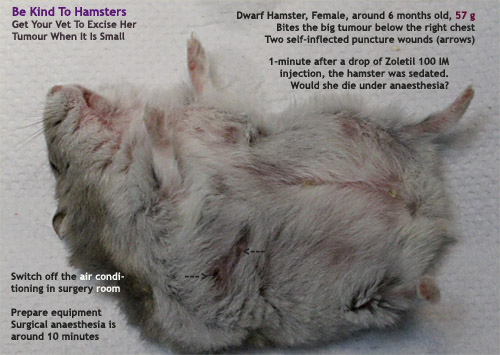
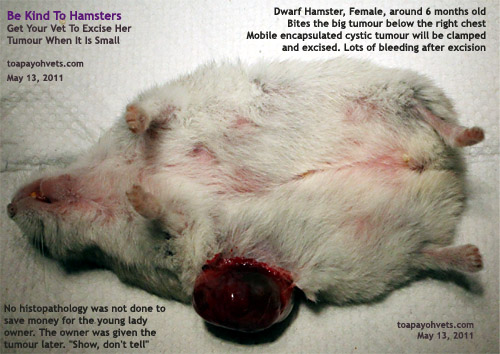
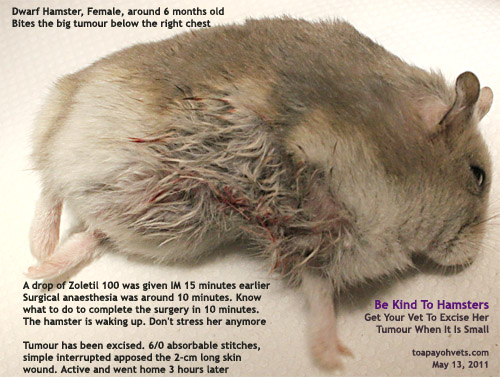
OPERATED IN MAY 2011 The effective dosage of Zoletil 50, at 0.01 ml diluted with 0.03 ml Hartman in one syringe and given IM can be ineffective if the dwarf hamster is plump (over 60 g). I have isoflurane gas top up and therefore, it is not a problem. However, it is effective in slim dwarf hamsters of around 50 g bodyweight. PLUMP HAMSTERS Last week, I operated on a dwarf hamster, 57 g just using Zoletil 100 at 0.01 ml with 0.03 ml Hartman's solution in one syringe without the need for isoflurane gas top up. Surgery is faster if there is no need to top up. Do note that Zoletil 100 is double the strength of Zoletil 50 and if you use it in slim dwarf hamsters, you need to reduce the volume by half (that is, use one half of one drop from the tip of a 1-ml syringe). This hamster went home to a happy lady owner 3 hours after surgery. Many hamster owners in Singapore wait till the tumour is large and irritating to the hamster before I see them. The anaesthetic risk is much higher. I don't look forward to operating on large tumours as there is a much higher chance of death on the operating table. A younger generation of Singaporeans nowadays do get their hamsters with tumours operated unlike 10 years ago. However, many vets prefer not to operate on hamsters and prescribe cream or oral medication. Pet shops also recommend some cream but the medicine invariably does not work at all. As around 50% of the 2 million voters in the Singapore General Elections 2011 are born after 1965, there is this young generation who is internet savvy and do lots of research.
|
|||||||||
|
|||||||||
|
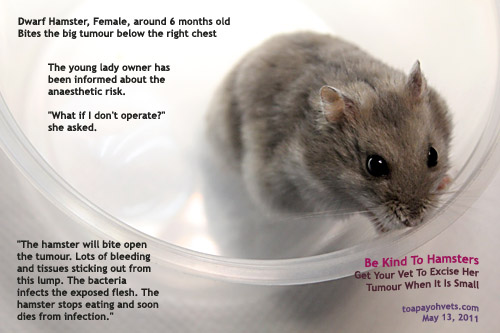
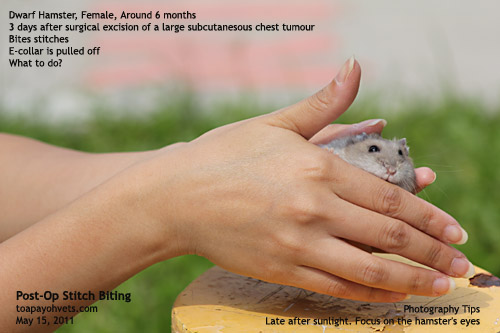
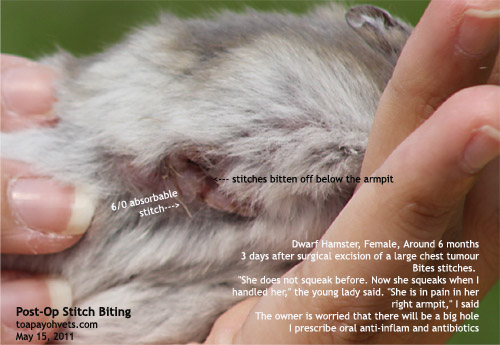
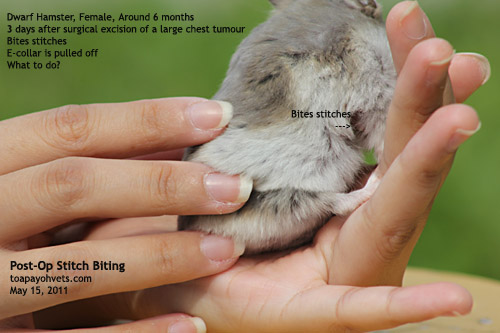
3 days after surgery, the
owner phoned me to say that
the hamster was biting off
her stitches and pulling off
her home-made e-collar. What
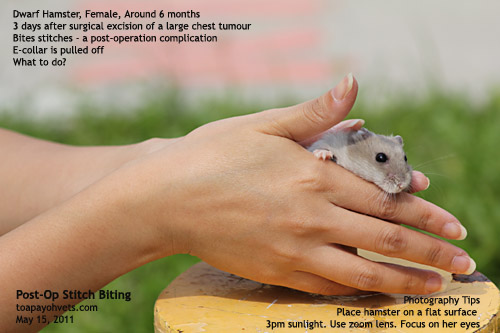
should she do? Usually, I hospitalise the hamster for one day for observation after surgery. I had sent the hamster home 3 hours after the surgery as I did not think she would survive, due to the lots of bleeding after excision of the tumour. Therefore, it would be good for the young girl to spend some time with the hamster. On Day 3, the young girl phoned me as the hamster bit off one area under the armpit, showing some yellowish gap. "Are you sure?" I asked. "Yes, the whole area was fully stitched up. There were no holes." I checked and said: "It is a small gap and should heal. I will give you the antibiotics and anti-inflammatory medicine." The hamster squeaked every time she carried her and she said that this hamster had never squeaked before. "She is feeling the pain in the right armpit," I said. But this hamster did not bite. I put the hamster on the receptionist counter which was a good height as the other clients were watching. Then I enveloped the hamster's body with a white towel so that she could not move and pushed 2 drops of medication into her mouth. The hamster would not open her mouth for the medicine and some pink syrup spilled outside her lower lips. "Take a tissue and wipe off the excess medicine," I showed the girl how to do it. Also, how to make an e-collar using a thicker paper and taping it. As I write now, 2 days later, no news from her. I presumed all are well. Medication is usually given after tumour excision but this was not done. Not all hamster need medication post-operation. In any case, the hamster was eating. The problem was stitch biting as the area under the armpit was stitched quite tight. 6/0 stitches, simple interrupted at 3-mm intervals. The incision involved the armpit and so it was quite difficult for this active hamster to exercise. It was the location of the large tumour that extended to the below of the armpit. Early removal when it is small would be ideal. It was a fine sunshine Sunday afternoon. So I asked the young lady to permit me to take some pictures of the hamster's armpit to illustrate the wound. She was happy to help me document this interesting case and held the hamster on top of a yellow iron pole outside the surgery. Not much photographic success for me as you can see that I could not really get excellent zooming of the armpit with the few images I shot. I did not want to stress the owner or hamster and therefore took the pictures in less than 1 minute with a steady hand while she was supposed to rest her hand on top of the yellow pole to stabilise the images. P.S. Time management on this busy Sunday was important. If I taught the girl how to medicate the hamster inside the consultation room which was occupied by my associate vet or in another room, I would waste several precious minutes by not attending to the clients at the reception counter. Some appeared quite impatient as their appointment times with my associate vet were not according to schedule. |
|||||||||
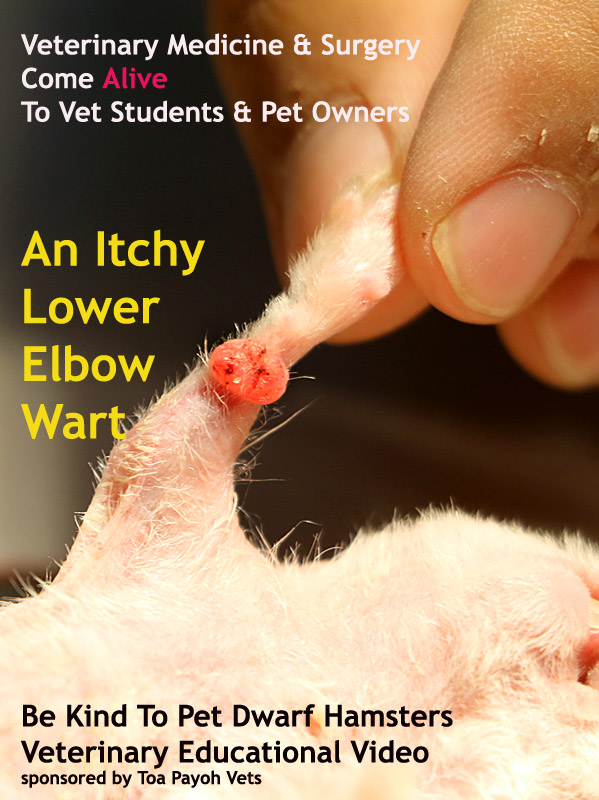
| ISOFLURANE GAS ANAESTHESIA IN A DWARF HAMSTER OPERATED AT TOA PAYOH VETS IN DEC 2014 | |||||||||
| If the surgery is in a split second, as in the above case, I use isoflurane gas to anaesthesize the dwarf hamster inside a container. The hamster is carefully observed. He will be taken out of the container when he is sleepy and not active. Electro-excision of the wart took less than one second. The hamster wakes up a few seconds after the excision and is active. This is much safer than injectable anaesthesia. | |||||||||
|
Advertisement |
|||||||||
|
|
|||||||||
 More
info at:
Dogs or
Cats More
info at:
Dogs or
CatsTo make an appointment: e-mail judy@toapayohvets.com tel: +65 6254-3326 or 9668-6469 |
|||||||||
|
|||||||||
|
Copyright ©
Asiahomes Internet |